Custom Orthotics in Goodyear, AZ
Prescription custom orthotics designed by
Dr. Craig Udall, DPM, the West Valley's specialist in lower-extremity biomechanics. Real foot pain relief that starts with how you actually walk, not a one-size insert pulled off a drugstore rack. Same-week evaluations available. Se habla español.
What Are Custom Orthotics?
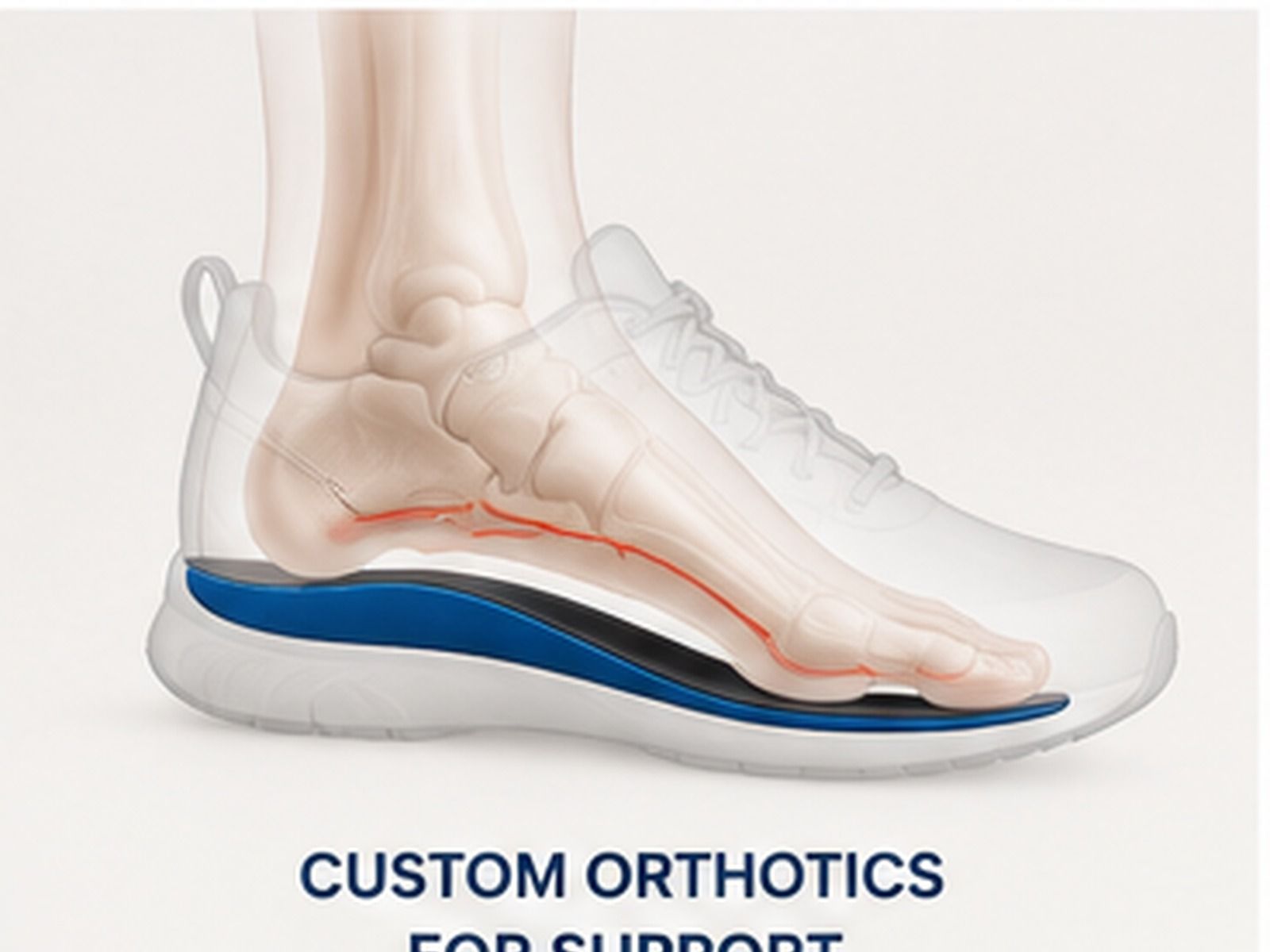
Custom orthotics are prescription shoe inserts. They are designed by a podiatrist to match your specific feet, your specific gait, and the specific problem you are trying to solve. That last part matters. A custom orthotic is not just a more expensive arch support. It is a medical device that corrects how the bones, joints, and soft tissues in your foot move when you walk, stand, and run.
The inserts you can buy off a shelf at Walgreens are mass-produced. They give general arch support to general feet. That is fine if your feet are average and your problem is mild. But by the time most people are searching for custom orthotics, they have already tried the drugstore option and it did not solve the problem.
Custom orthotics are different because they start with you. We measure how you walk. We look at your foot structure, your joint alignment, and the kinds of activities you put your feet through every day. Then we design an insert that fixes what is actually wrong, not what is generically wrong.
Conditions Custom Orthotics Help
Custom orthotics help with more than just foot pain. They often relieve symptoms higher up the chain too, because so many lower-leg, knee, hip, and lower-back problems start with how the foot moves. Here are the conditions we treat with them most often.
List of Services
-
Plantar fasciitis and heel painList Item 1
Custom orthotics support the arch in a way that takes the strain off the plantar fascia. For many patients with chronic heel pain, the right pair of orthotics is the single biggest piece of the treatment plan.
Learn more about plantar fasciitis treatment.
-
Flat feet (pes planus)List Item 2
Flat feet do not always cause problems, but when they do, the cause is usually how the foot collapses under load. Custom orthotics provide structured support that prevents the collapse and reduces pain in the foot, ankle, knee, and lower back.
Learn more about flat feet treatment.
-
BunionsList Item 3
Orthotics do not reverse a bunion, but they slow its progression, redistribute pressure away from the joint, and relieve pain so you can stay active without surgery.
Learn more about bunion treatment.
-
Hammer toesList Item 4
Custom orthotics with the right padding and metatarsal support can take pressure off hammer toes and reduce the friction and pain that come with them.
Learn more about hammer toe treatment.
-
Drop foot
For drop foot patients, custom orthotics paired with the right brace can dramatically improve gait and reduce the risk of falls.
Learn more about drop foot care
-
Diabetic foot care
For diabetic patients, the goal of an orthotic is often to prevent skin breakdown by offloading pressure from at-risk areas. Soft, accommodative orthotics are common here, and Medicare often covers them under the therapeutic shoe benefit. We screen, measure, and prescribe under that benefit.
-
Athletic and sports use
Runners, court athletes, hikers, and active patients in the West Valley use custom orthotics to prevent injury and improve performance. We build orthotics specifically for athletic shoes, with different posting and material choices than the ones we build for dress shoes or work boots.
-
Foot, knee, hip, and lower back pain from gait issues
When a problem comes from how you walk, the fix often starts at your feet. Custom orthotics realign the chain from the ground up.
Functional vs. Accommodative Orthotics
There are two main categories of custom orthotics. Knowing the difference helps explain why an orthotic is built the way it is.
Functional orthotics
Functional orthotics correct how your foot moves. They are typically made from semi-rigid materials like plastic, carbon fiber, or graphite. They are the right choice when the goal is to change biomechanics, such as when the foot overpronates or supinates during gait. Most patients with plantar fasciitis, flat feet, or gait-related pain are good candidates for functional orthotics.
Accommodative orthotics
Accommodative orthotics cushion and redistribute pressure. They are made from softer materials like EVA foam, Plastazote, or memory cushion. They are the right choice when the goal is to protect the foot rather than correct it, such as in diabetes, arthritis, painful calluses, or foot ulcers.
Hybrid and activity-specific orthotics
Some patients get a hybrid that combines both, with a firm shell and a softer top layer. We also build orthotics specific to the kinds of shoes you wear. Running orthotics are different from dress shoe orthotics, which are different from work boot orthotics. If you spend long days in steel-toed boots, your orthotic should be built for that. If you compete in court sports, same idea.
How We Make Your Custom Orthotics
1. Evaluation and gait analysis
You sit down with Dr. Udall for a full lower-extremity exam. We look at your foot structure, joint range of motion, alignment, and any pain points. Then we watch how you walk, often barefoot first, then in your usual shoes. Gait tells us what your feet are actually doing under load. That is information you cannot get from a static foot exam alone.
2. In-office imaging when needed
For many patients, the exam and gait analysis are enough. For others, we use in-office digital X-ray to confirm joint alignment or rule out structural issues. Imaging happens during your visit. You do not have to drive somewhere else.
3. Casting or 3D scan
We capture a precise impression of your feet using either a plaster cast or a 3D foot scan, depending on your case. This is what your orthotics will be built from. Both methods are non-invasive and take just a few minutes.
4. Custom manufacture
Your impressions and prescription go to a specialty orthotic lab. The lab builds your orthotics to Dr. Udall's exact specifications, including material, thickness, post angles, top cover, and shoe type. This typically takes two to three weeks.
5. Fitting and follow-up
When your orthotics arrive, you come back in for a fitting. Dr. Udall checks the fit in your shoes, watches you walk in them, and makes any small adjustments needed. We schedule a follow-up visit to make sure they are working as designed and to fine-tune them if anything feels off.
Custom Orthotics vs. Over-the-Counter Inserts
The most common question we get is whether custom orthotics are worth the cost when drugstore inserts are right there for thirty dollars. The honest answer is that they serve different purposes.
A drugstore insert gives generic cushioning and general arch support. It is a reasonable starter for people with mild discomfort, no specific diagnosis, and average foot structure. Some patients find real relief with one. We genuinely recommend trying them first if your problem is mild and recent.
Custom orthotics solve specific medical problems. They are prescribed after an exam. They correct your specific gait, not a generic gait. They use materials and post angles chosen for your condition. They are sized for your shoes and your feet, not a small, medium, or large range. And they last years instead of months, which is part of why the long-term cost difference is smaller than it looks at the register.
If a drugstore insert has fixed your problem, you do not need custom orthotics. If you have tried drugstore inserts and you are still in pain, custom is almost always the next step.
| Feature | Drugstore Insert | Custom Orthotic |
|---|---|---|
| Designed for your foot | No, generic shape | Yes, from your impression |
| Based on a medical exam | No | Yes |
| Corrects gait | Limited | Yes |
| Lasts | Months | 2 to 5 years |
| Insurance often covers | No | Sometimes, varies by plan |
| Best for | Mild, recent issues | Diagnosed conditions |
Cost, Insurance, and Medicare
Custom orthotic costs vary depending on the type, the materials, and whether your insurance covers them. We will always give you a clear cost estimate before any work starts.
Insurance
Many major insurance plans cover custom orthotics when they are medically necessary. We verify your benefits before we proceed so you know what your out-of-pocket cost will be.
Medicare
Original Medicare does not cover most custom orthotics on its own. It does cover therapeutic shoes and inserts for diabetic patients under the therapeutic shoe benefit. Some Medicare Advantage plans offer broader orthotic coverage. For our patients in Sun City and Sun City West, this is a question we get often, and the answer depends entirely on your specific plan. Call us and we will check.
HSA and FSA
Custom orthotics are an eligible expense for both HSA and FSA accounts.
Self-pay
We offer self-pay rates for patients without coverage. Ask us when you call.
How Long Do Custom Orthotics Last?
A well-built pair of custom orthotics typically lasts two to five years for most adults. The exact lifespan depends on your weight, your activity level, the kinds of shoes you wear them in, and the material your orthotics are built from. Athletes and people who walk for work tend to be on the shorter end. Patients who use orthotics in dress shoes or for limited daily wear tend to be on the longer end.
Top covers can usually be replaced before the orthotic itself needs replacing, which extends the useful life. Signs that your orthotics are nearing the end of their life include visible compression of the materials, return of the pain symptoms they originally fixed, or cracking and visible wear on the shell. When that happens, bring them in. We can often refurbish them or build a new pair from your existing prescription, which saves on the full evaluation process.
Frequently Asked Questions About Custom Orthotics
Are custom orthotics worth it?
For most patients with a real foot problem, yes. They solve issues that drugstore inserts cannot, they last years, and they often prevent the need for more invasive treatment later. If you have tried over-the-counter inserts and they did not help, custom orthotics are usually the next logical step.
Can I wear custom orthotics in any shoe?
Most shoes, yes. We design orthotics to fit the type of shoes you actually wear. Patients who wear a mix of dress shoes, running shoes, and work boots sometimes get more than one pair so the orthotic matches the shoe.
Does Medicare cover custom orthotics?
Usually not on its own. Original Medicare covers therapeutic shoes and inserts for diabetic patients under a specific benefit, but it does not cover most other custom orthotics. Some Medicare Advantage plans do. Call us at 623-335-4017 and we will check your specific plan.
How long does it take to get my orthotics?
About two to three weeks from your casting or scanning visit to when your orthotics are ready for fitting.
Will my feet feel weird at first?
Often, yes, especially in the first few days. Custom orthotics change how your feet move, and that takes a short adjustment period. Most patients break them in by wearing them for short stretches at first, then gradually increasing wear time over a week or two. Any discomfort that does not go away should be reported. Small adjustments are part of the process.
What is the difference between custom orthotics from a podiatrist and the ones from a mall kiosk?
Kiosk orthotics are typically built from a static foot scan and a generic prescription. They are a step above drugstore inserts, but they do not involve a medical exam, a gait analysis, or a doctor-driven prescription. A custom orthotic from a podiatrist is a medical device built for your specific condition by someone trained to diagnose and treat that condition.
¿Habla español?
Sí. Dr. Udall y nuestro equipo hablan español con fluidez. Llame al 623-335-4017 para programar una evaluación.
Related Conditions We Treat
With Custom Orthotics
Flat Feet
Custom orthotics, supportive bracing, and conservative care for flat feet (pes planus). Veteran and Luke AFB community welcome.
Hammer Toes
In-Office Treatment
Conservative care first, with a minimally-invasive in-office procedure for flexible hammer toes when needed. Less downtime than traditional surgery.
Heel Pain &
Plantar Fasciitis
The most common foot pain we see — and the most treatable. Real relief through stretching, custom orthotics, and conservative care.
Drop Foot
Diagnosis, AFO bracing, and rehabilitative care for drop foot. We figure out the cause and build a plan — conservative care first.
Bunions
From mild bunions to advanced cases, we start with conservative care — footwear, padding, custom orthotics — and only consider surgery when nothing else has worked.
Foot & Ankle Pain
Not sure what’s wrong? Our foot pain triage page helps you identify what you’re feeling — top-of-foot, ball-of-foot, arch, or ankle pain.
Book Your Custom Orthotic Evaluation
The first step to custom orthotics is a real evaluation. Dr. Udall will examine your feet, watch you walk, and tell you whether custom orthotics are likely to help with your specific problem. If they are not the right answer, we will tell you that too.