
Ingrown Toenail Removal in Goodyear, AZ
That sharp, throbbing pain along the edge of your toenail. The redness. The way it hurts to put on any shoe. We see ingrown toenails every week, and we treat them the same week you call.
Dr. Craig Udall, DPM performs a gentle in-office procedure that gets you out of pain fast and, with the permanent removal option, can keep it from coming back. Same-week visits. Se habla español.
Call Us Today If You Have Any of These Symptoms
Some ingrown toenails are mild and can wait a few days. Others are infections that need attention right now. Call us at 623-335-4017 the same day you notice any of these:
- Yellow, green, or white pus draining from the toenail.
- Redness that is spreading up the toe or into the foot.
- A fever along with the toe pain.
- The toe feels hot to the touch.
- The pain has gotten significantly worse over the last 24 hours.
- You have diabetes or are immunocompromised and you have any signs of infection in the toe.
We can usually see urgent cases the same day. Do not wait this out. Untreated infected ingrown toenails can become serious, especially for patients with diabetes or circulation issues.
What Is an Ingrown Toenail?
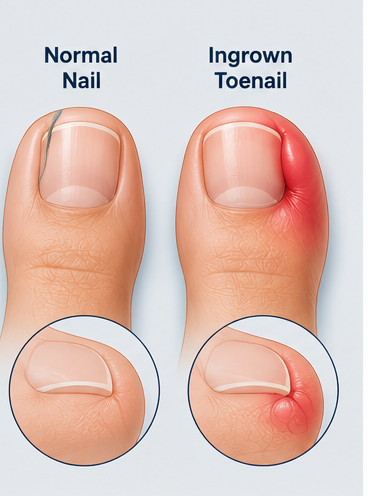
An ingrown toenail happens when the edge or corner of a toenail grows down into the skin next to it instead of out over it. The most common place is the big toe, usually along one of its sides. As the nail grows into the skin, it creates a small break, and bacteria use that opening to cause irritation, redness, and eventually infection.
What starts as a slight tenderness can become a real problem within a few days. The longer an ingrown toenail goes untreated, the more likely it is to get infected and the more involved the treatment usually needs to be.
Symptoms of an Ingrown Toenail
The classic signs are:
- Sharp pain along one edge of the toenail.
- Redness and swelling at the side of the nail.
- Tenderness when something touches that part of the toe, like a shoe, a sock, or a bed sheet.
- Skin that feels firm or hard around the edge of the nail.
- Drainage or pus if infection has started.
- A small bump of raised skin that has started growing over the edge of the nail (called proud flesh or granulation tissue) in more advanced cases.
Most patients can identify an ingrown toenail on their own. What patients cannot tell on their own is whether it has become infected and how aggressive the treatment needs to be. That is what an exam answers.
Why Home Treatment Often Does Not Work
The internet is full of advice for treating ingrown toenails at home. Some of it is reasonable for very mild cases. Most of it is not. Here is an honest assessment.
What sometimes helps for very mild cases
Soaking the foot in warm water with Epsom salt for 15 to 20 minutes a few times a day.
Keeping the area clean and dry between soaks.
Avoiding tight or closed-toe shoes while the area is sensitive.
Gently lifting the nail edge with a small piece of cotton, but only if the nail is not already deep into the skin.
What does not work and often makes things worse
Cutting the nail yourself with regular nail clippers, which can leave a sharp spur in the skin and trigger an infection.
Digging at the nail with anything from home.
Applying creams that are not specifically for this.
Waiting it out once infection has started.
The hard truth is that once the nail has grown into the skin, soaking and creams will not move it. Only removing the offending piece of nail solves the underlying problem. For mild cases caught early, that fix is fast and simple in our office. For more advanced cases, it is more involved but still routine.
How We Remove an Ingrown Toenail
The standard treatment for a problematic ingrown toenail is a procedure called a partial nail avulsion. For patients with recurring ingrown toenails or curved nail shapes, we usually combine it with a chemical called phenol to prevent the same portion of the nail from growing back. It sounds more involved than it is.
Why Patients See Dr. Udall for Ingrown Toenails
Ingrown toenails are one of the most common reasons patients walk into Foot Envy. Dr. Udall has been treating them since 2017 and has performed the in-office procedure many times across his career. The procedure is short, the technique is gentle, and the recurrence rate is very low when the permanent removal option is used.
He is board certified, fellowship trained, and a member of the American Podiatric Medical Association (APMA) and the American College of Foot and Ankle Surgeons (ACFAS).
What Causes Ingrown Toenails?
A handful of things cause ingrown toenails, and most patients have more than one of them at the same time.
Cutting toenails too short or rounded
This is the single most common cause. When a nail is cut short and rounded at the corners, it can grow into the skin as it grows out. Nails should be cut straight across, not curved at the edges.
Tight shoes
Shoes that squeeze the toes together push the nail edge into the surrounding skin. Closed-toe dress shoes, narrow athletic shoes, and shoes that are simply too small are common culprits.
Injury to the toe
Stubbing the toe hard, dropping something on it, or repeated trauma from running and sports can change how the nail grows back. Runners are especially prone.
Genetic nail shape
Some people are born with toenails that curve downward at the edges. Those nails are mechanically more likely to grow into the skin, and the permanent phenol removal is often the right answer for them.
Sweaty feet
Constantly damp skin softens the skin around the nail and makes it easier for the nail edge to push into it. This is more common in active patients and in our Arizona summer heat.
Nail fungus
Fungal infection can deform the nail shape and contribute to ingrowing. We often see the two together.
How to Prevent Future Ingrown Toenails
Most ingrown toenails are preventable with a few simple habits.
- Cut your toenails straight across, not in a curve.
- Do not cut them too short. Leave them roughly even with the tip of the toe.
- Use a nail file to gently smooth sharp corners rather than cutting them off.
- Wear shoes with enough room in the toe box. Narrow shoes are a major cause.
- If your feet get sweaty during the day, change socks midday or use a moisture-wicking sock.
- Treat any nail fungus that develops, because it changes how nails grow.
For patients with a genetic nail shape that makes recurrence likely, the permanent phenol removal we walked through above is what stops the cycle for good.
Frequently Asked Questions About Ingrown Toenails
How long does the procedure take?
Usually 15 to 30 minutes from numbing to finished. Most patients are in and out of the office within an hour total, including the consultation and aftercare review.
Does it hurt?
The only uncomfortable part is the numbing injection at the base of the toe, which takes a few seconds. After that, the toe is fully numb and you will not feel the procedure. Most patients describe mild soreness for a few days afterward, easily managed with over-the-counter pain medication.
Will I lose my whole toenail?
No, in almost all cases. We remove only the small offending edge of the nail. The rest of your nail stays. After healing, most patients cannot tell anything was removed.
Will the nail grow back?
That depends on whether we use the permanent removal option. Without phenol, the removed portion can grow back, and so can the ingrown nail. With phenol, the specific edge that caused the problem is permanently prevented from regrowing, and the recurrence rate is very low. We talk through which option is right for your case during the consultation.
How long until I can wear normal shoes again?
Most patients are back in their normal shoes within a few days. We usually recommend an open-toe or extra-roomy shoe for the first three to five days while the swelling is highest.
Can I shower after the procedure?
You can shower starting the day after the procedure. Just keep the toe out of standing water (no baths, pools, or hot tubs) for the first one to two weeks until the toe is mostly healed.
Does insurance cover ingrown toenail removal?
Yes. Most major insurance plans cover ingrown toenail treatment when it is medically necessary, including the in-office procedure. We verify your benefits before any work starts so you know what your out-of-pocket cost will be. We accept Medicare and most Medicare Advantage plans.
What if I have diabetes?
Call us right away. Diabetic patients with ingrown toenails are at higher risk for infection, and even a small problem can become serious. We see diabetic patients on a same-day or next-day basis for any toenail issue.
¿Habla español?
Sí. Dr. Udall y nuestro equipo hablan español con fluidez. Llame al 623-335-4017 para programar una cita.
Ingrown Toenail Related Conditions We Treat
Custom Orthotics
Prescription-grade custom foot orthotics designed by Dr. Udall, the West Valley’s dedicated specialist in lower-extremity biomechanics.
Hammer Toes
In-Office Treatment
Conservative care first, with a minimally-invasive in-office procedure for flexible hammer toes when needed. Less downtime than traditional surgery.
Heel Pain &
Plantar Fasciitis
The most common foot pain we see — and the most treatable. Real relief through stretching, custom orthotics, and conservative care.
Bunions
From mild bunions to advanced cases, we start with conservative care — footwear, padding, custom orthotics — and only consider surgery when nothing else has worked.
Foot & Ankle Pain
Not sure what’s wrong? Our foot pain triage page helps you identify what you’re feeling — top-of-foot, ball-of-foot, arch, or ankle pain.
Book Your Same-Week Ingrown Toenail Visit
If your toe hurts now, call us now. Most patients with painful ingrown toenails are seen within a few days, and urgent or infected cases are usually seen the same day. Dr. Udall will examine the toe, walk you through your options, and almost always treat the problem right then.